
By Dr Tristan Jenkinson
Introduction
June’s challenges were set by the team at the Association for Research into Crimes against Art, considering issues with provenance, sections of stolen paintings, and the property of historical figures on sale on the dark web.
Let’s dive in.
Funny Money
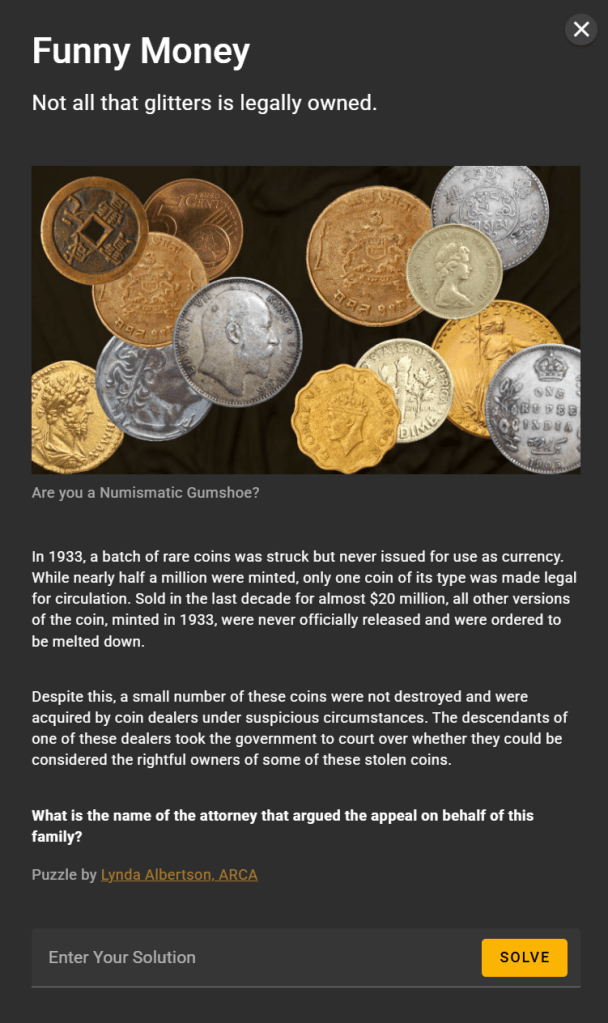
I went straight to ChatGPT to see if we could identify the answer to this one:

However, the solution we are looking for is not “Barry Berke”. I realised that, given the actual question (“What is the name of the attorney that argued the appeal on behalf of this family?”) my question was poorly phrased, as we are actually looking for the attorney who worked on the appeal, which could be different to the attorney on the original case.
I therefore followed up with:
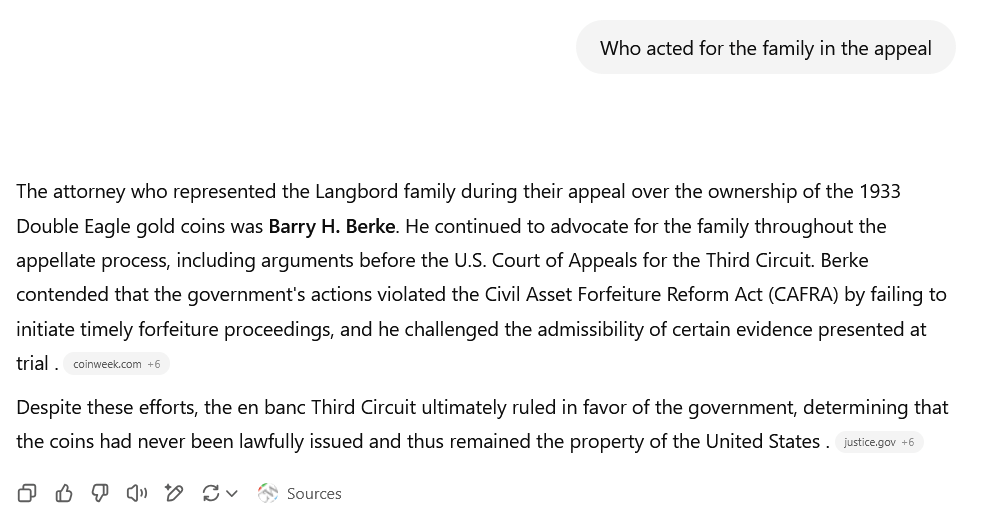
We know Barry Berke is not the answer… But notice the specification of Barry H. Berke… Let’s go back to some original supporting material.
Following the supporting link provided by ChatGPT, I went to https://coinweek.com/appeals-court-rules-u-s-govt-langbord-1933-double-eagle-fight/. There I was able to find the name of the case itself Langbord et al v. U.S. Department of Treasury et al (Case No. 12-4574). Looking this up, I was able to locate the published opinion from the case, https://law.justia.com/cases/federal/appellate-courts/ca3/12-4574/12-4574-2016-08-01.html.
We can now pull out the details of those involved, including the listing of the attorneys for the appellants:

So it appears that Barry Berke’s name is officially written as Barry H. Berke, and indeed, this is the solution that we are looking for.
Solution: Barry H. Berke
Edward Scizzorhands: Art Thief
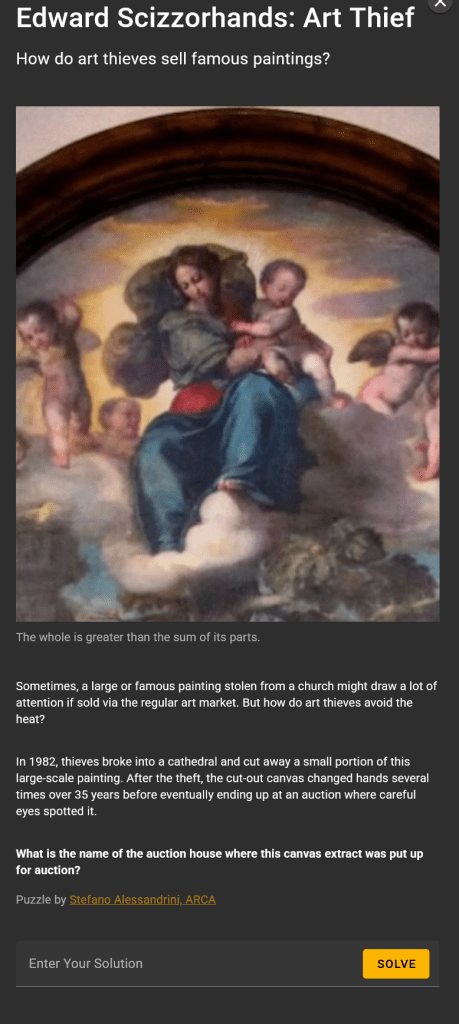
Again, I headed to ChatGPT:

It is important to note that the answer here is incorrect, Scottsdale Art Auction is not the auction house that we are looking for. This is one of the key reasons why you check anything that ChatGPT (or other Generative AI systems) provides to you.
The answer does however, provide us with useful information. In particular the link provided with the answer is useful. https://www.finestresullarte.info/en/art-and-artists/the-incredible-story-of-federico-barocci-s-rediscovered-fragment provided me with a link to the actual auction itself – https://wannenesgroup.com/auctions/dipinti-antichimaggio-2017/. Following this, the answer should therefore be Wannenes.
The page on finestresullarte now appears to have been put behind a paywall, and has also been removed from Wayback Machine. The article itself provided a good summary of the case. Though I had not planned on providing detailed content from the page, this issue does highlights an important aspect of OSINT work – ensure that any information that you may want to use in the future is captured, during your investigation, as it may not still be publically available when you come to write up your findings, or when you need to rely on them to support your findings.
To provide more information about the case itself, I used ChatGPT to summarise the details of the article, which it has clearly considered the content from:
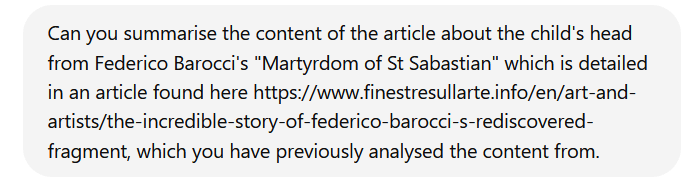
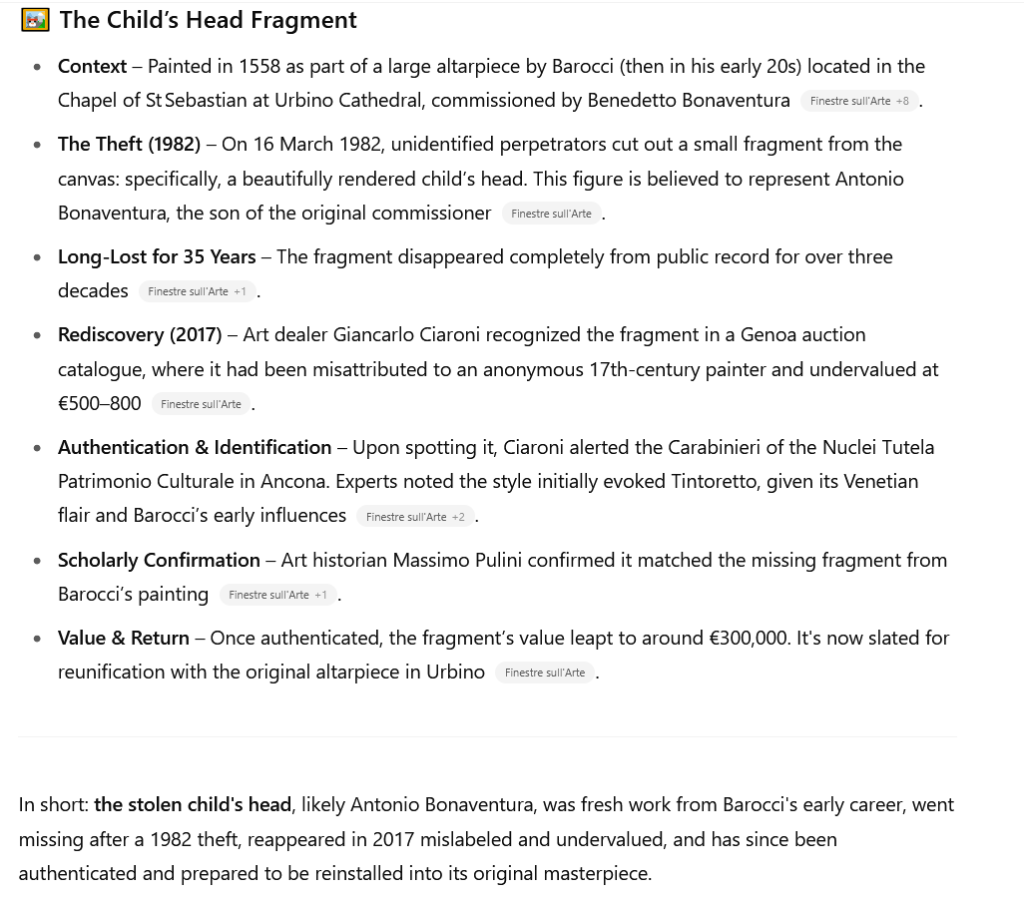
The link to the finestresullarte.info page on Google, also includes an image of the child’s head which was present on the fragment:
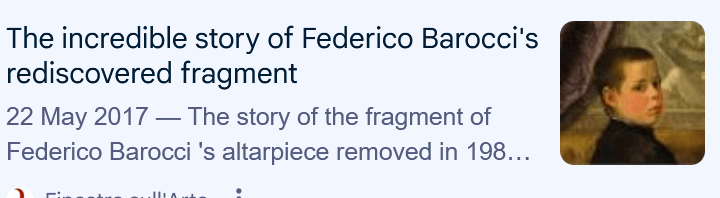
Using this image, and Google Images, I was able to find other discussions on the same story.
The story of the paintings theft, and rediscovery is also covered in https://www.ilgiornale.it/news/spettacoli/cos-piccolo-antonio-rapimento-tornato-nel-dipinto-1446017.html, https://www.sharry.land/en/wonders/il-fanciullo-rapito and https://www.corriereadriatico.it/pesaro/urbino_barocci_repurato_catalogo_quadro_sgarbi_polemica-2458227.html the last of which explicitly lists the Wannenes auction house.
Solution: Wannenes
Denial of Provenance

My solution to this challenge was a little circuitous… only once I had found the solution did I understand the implication seeded in the challenge itself.
The first step I took was to identify the painting – which was an easy step with ChatGPT (and then checked by googling the name of the painting provided!)

We can also use ChatGPT to see what information it can provide on the provenance (and importantly we want a link to the information so that we can check it ourselves):

We have our link to go and check the information, so this is the logical next step to check – https://www.metmuseum.org/art/collection/search/437986:
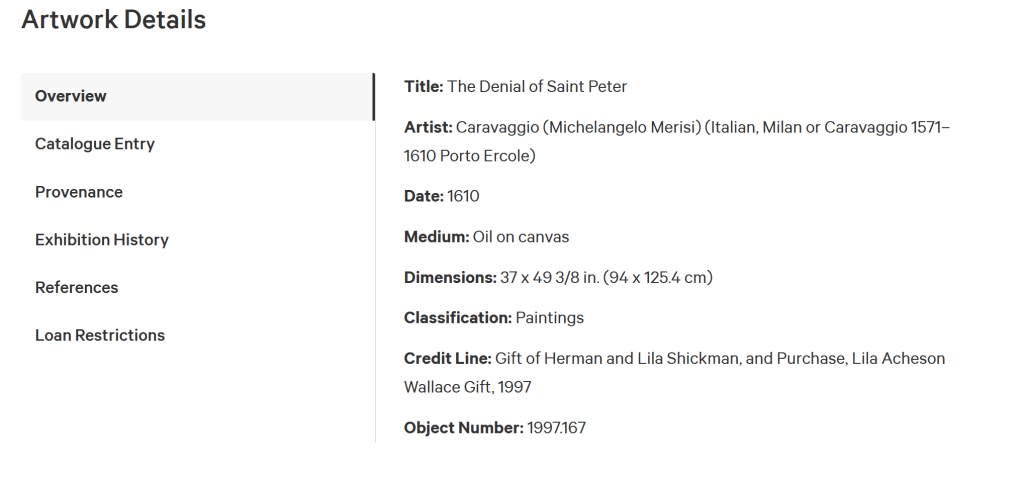
And the provenance details:

I was hoping to locate the mistake within the provenance record that may provide further information about the relevant possessor listed in the challenge.. I picked up on the phrase “said to remain with the Savelli family”, which seems to relate to the period from 1650 to 1952, but with no real evidence. I also noted that the challenge specifically suggested that phrases like “from a private Swiss collection” could be indicators of a contentious history. While we do not see similar phrases here, we do have private ownership in Switzerland, apparently in 1970.
I decided to run the provenance listed by The Met through ChatGPT to see if it could identify any inconsistencies, mistakes or issues.
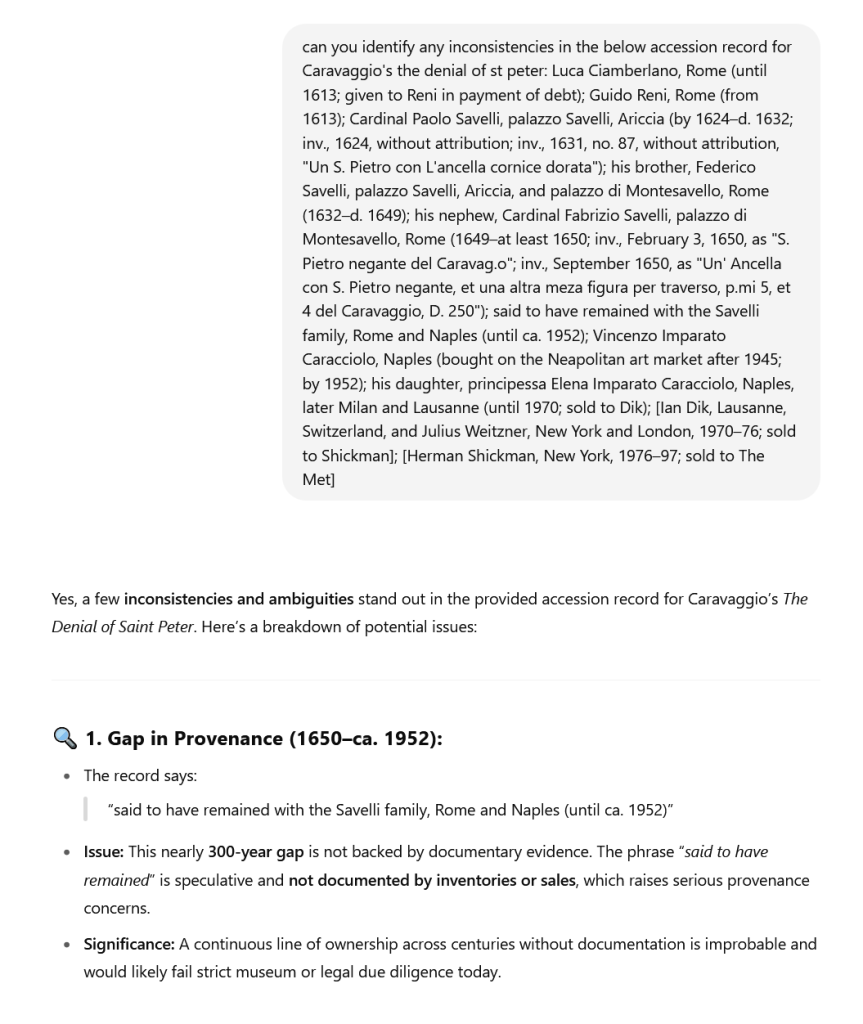

I was not able to identify the mistake in the record. But it was clear that there are some potential issues around the time of WW2, the 300 year period that the painting was supposedly with the Savelli family, and the apparent (undocumented) sale on the Neapolitan flea market.
These suggest that this painting could well have been part of Nazi plunder during the war. It is well documented that there was a significant amount of art theft in occupied territories during the war (see for example https://en.wikipedia.org/wiki/Art_theft_and_looting_during_World_War_II).
I therefore did some Googling, hoping to tie in the specific date mentioned in the challenge – 14 May 1942.
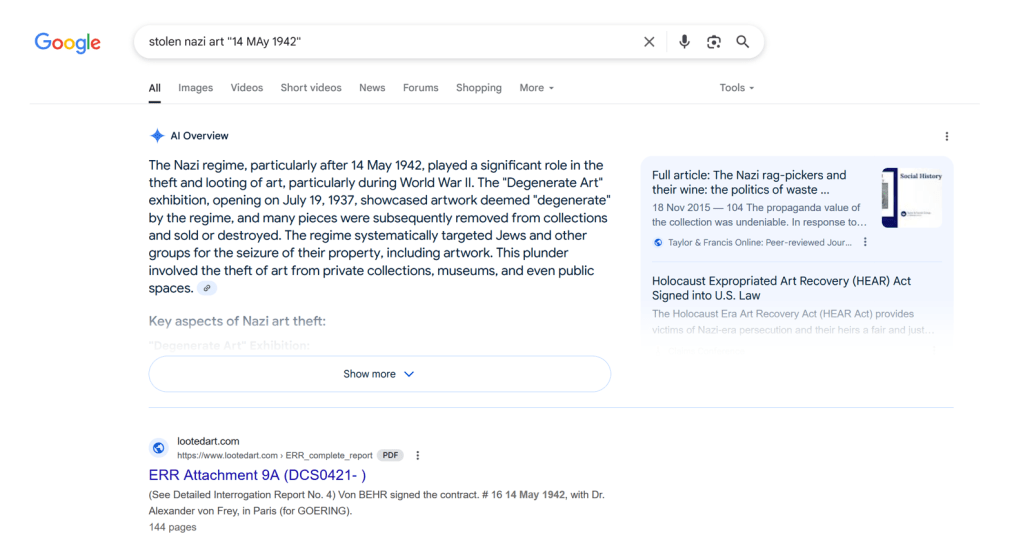
The first hit from this search identified a report listed on “lootedart.com” – https://www.lootedart.com/docs/ERR_complete_report.pdf.
A hit further down the page relates to https://lootedart.com/web_images/pdf2024/Pt%25201%2520activity%2520einsatzstab%2520rosenberg%2520france%252001.pdf this appears to be scans of original documents, linked to the complete report.
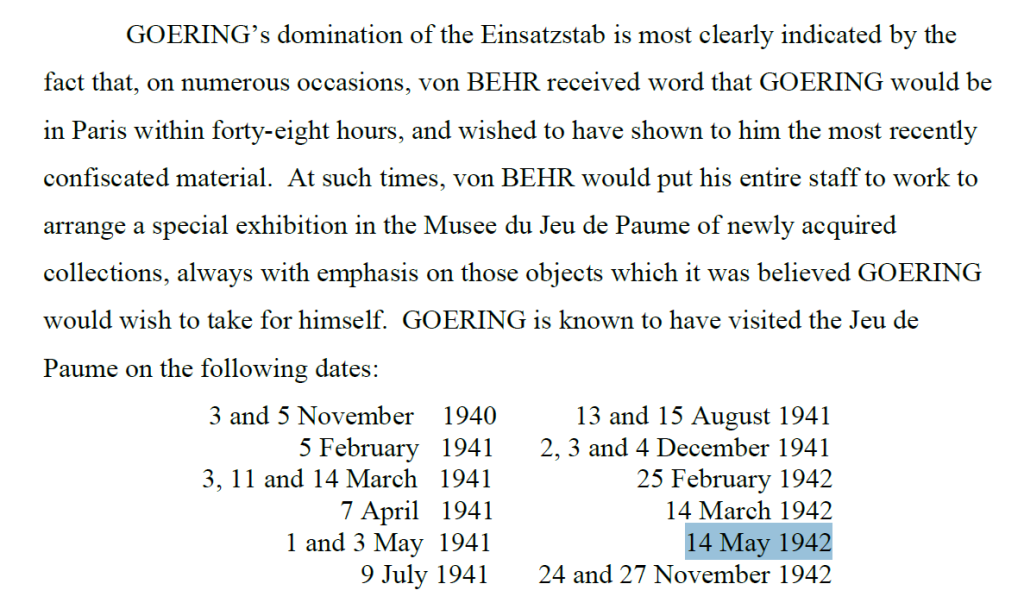
Viewing the complete report, there are three hits on “14 May 1942”. The first provides a list of dates on which Goering is known to have visited the Jeu de Paume, at which times he would be shown confiscated art works.
The “Pt 1 activity einsatzstab rosenberg france 01” file appears to show the original scan of this text:
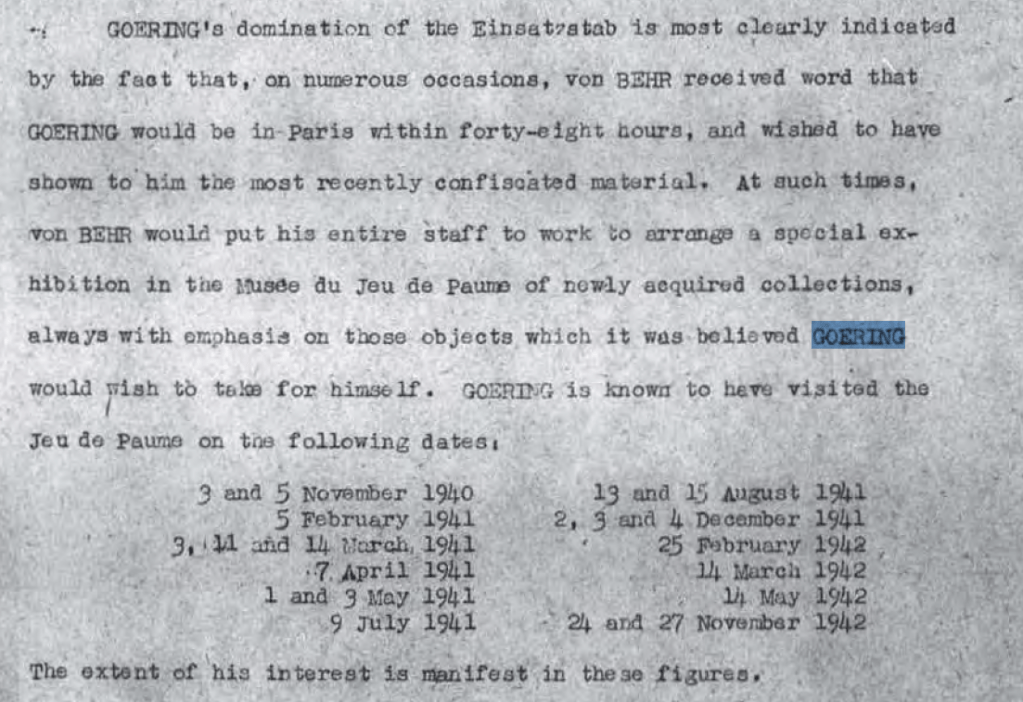
We therefore know that on the date in question, Goering was reportedly at the Jeu de Paume to view artworks.
The second hit on 14 May 1942 appears within a section titled “Details of Exchanges” and is exchange number 16, between Goering and Dr Alexander von Frey:

The third hit is the most interesting. It is the next listed exchange (number 17), and details an exchange between Goering and Jan Dik Jr.:

In particular, the details of the exchange are helpful here, identifying that Jan Dik Jr attended personally:
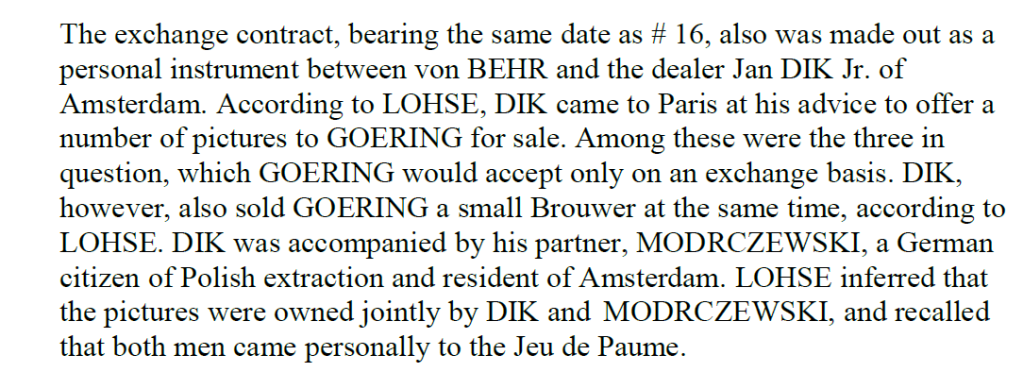
And from the document of scans:
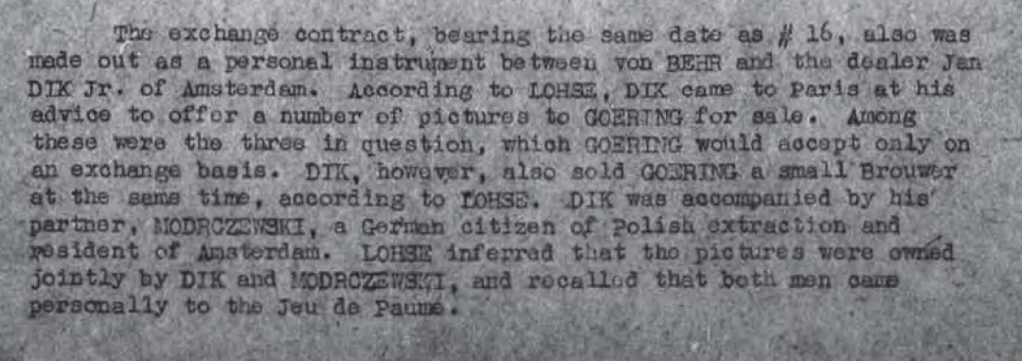
We therefore have Jan Dik Jr meeting Goering in person, on the date of interest.
It is only here that it is easier to see the apparent mistake in the provenance record. It appears that perhaps the provenance record should record Jan Dik Jr. Not Ian Dik.
Indeed, if we look at https://www.nicholashall.art/journal/caravaggio-in-america-part-3/, this discusses The Denial of St Peter at the Met.
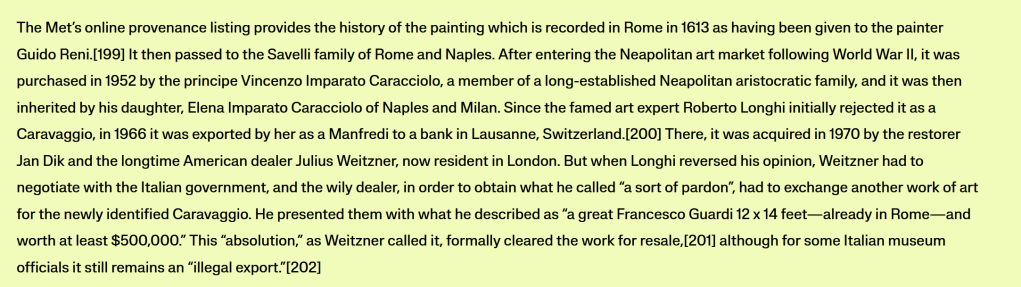
Here we can see that Jan Dik worked with Julius Weitzner, so it appears that “Ian Dik” should have been listed as Jan Dik Jr in the provenance record.
This means that the meeting detailed in the LootedArt report is the one that we are looking for, between Jan Dik and Goering. From the information already seen, we know that this meeting happened at the Musee de Jeu de Paume.
Solution: Jeu de Paume
Mummy’s Little Helper

This was very straight forward, compared to the previous challenge. Running a simple Google, including the specific amount paid, leads us to the information that we want:
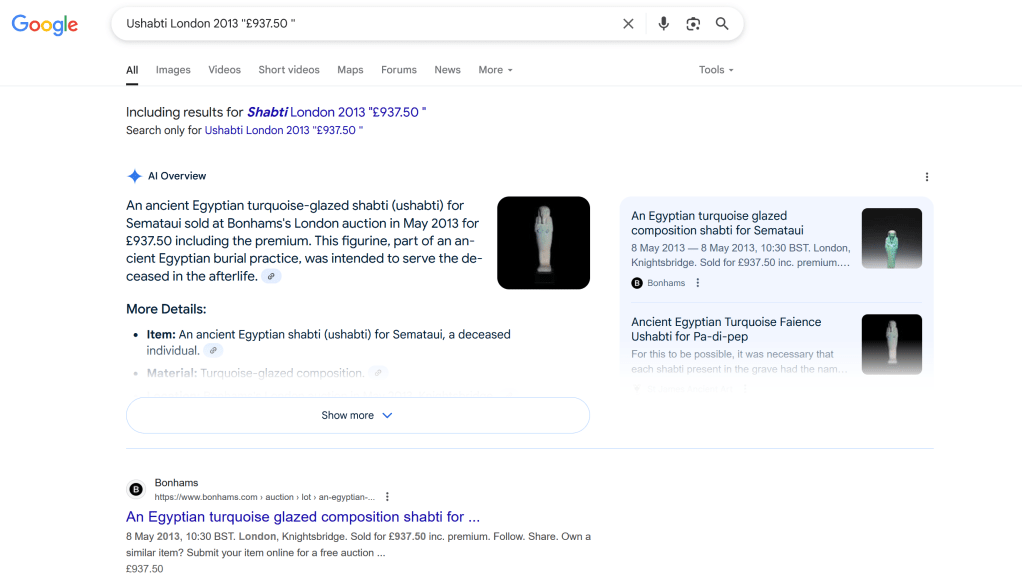
Immediately in the first search result we have an item sold at Bonhams in the correct year for the correct (and very specific) price.
Following the Bonhams link (https://www.bonhams.com/auction/20667/lot/337/an-egyptian-turquoise-glazed-composition-shabti-for-semataui/) we find the page for the item:

We can see that this ushabti is for Semataui, and as above, it was sold at Bonhams.
Solution (Noting the required format): Bonhams Semataui
Proceeds of War

My first step was to identify who the owner is, so that we can then search for details of sales on the dark web. I sued ChatGPT.

This was then verified using simple Google searches to confirm. As part of this I rana simple search for Puyi, with the below results:
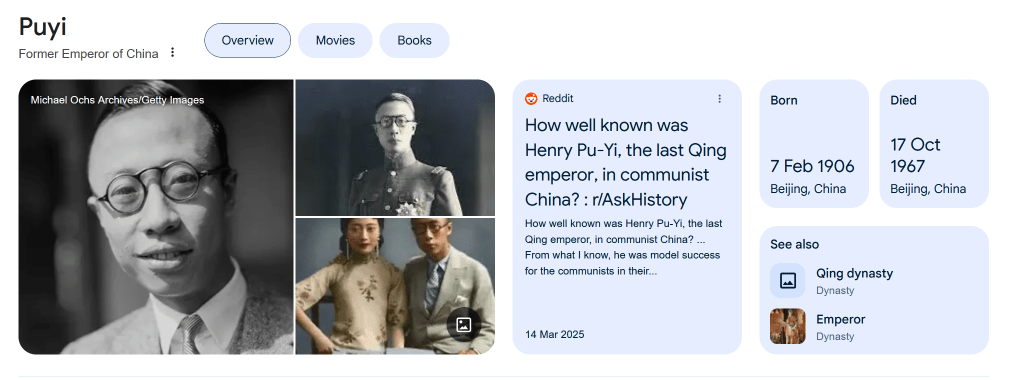
I ran some searches looking for Puyi and dark web content but was not able to find anything relevant.
Note the Reddit entry in the search results above. These list Puyi as Pu-Yi. It appears that there are alternative spellings, indeed, a quick Google identifies that:
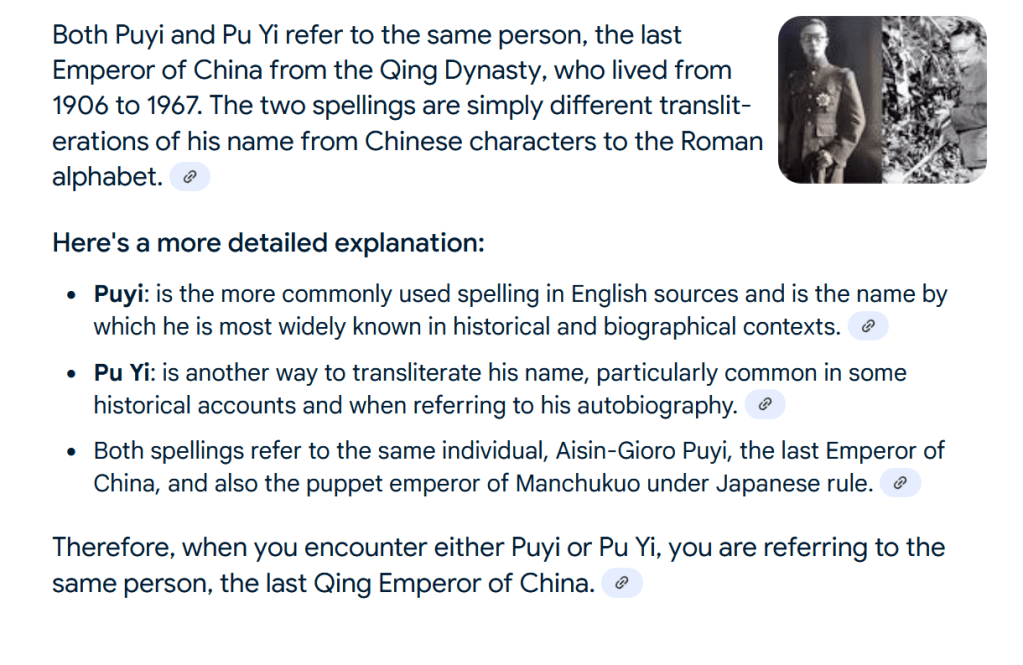
I therefore ran a search for “Pu Yi” and “dark web”:

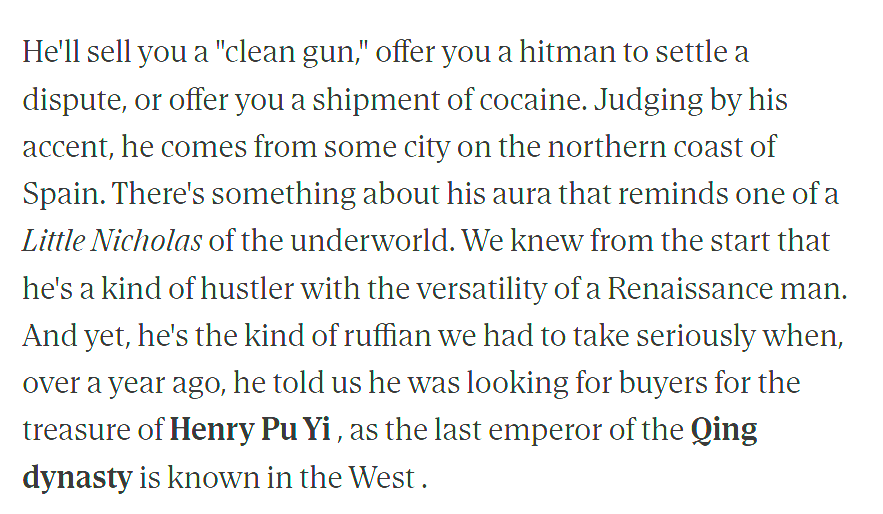
This El Mundo article can be found here – https://www.elmundo.es/cronica/2023/10/30/653c36cb21efa052208b45a5.html. I opened using Google Chrome, and used the translation function. Some of the content is shown below:
We can also see an image of a dagger, that appears to be one of those in the original challenge image:
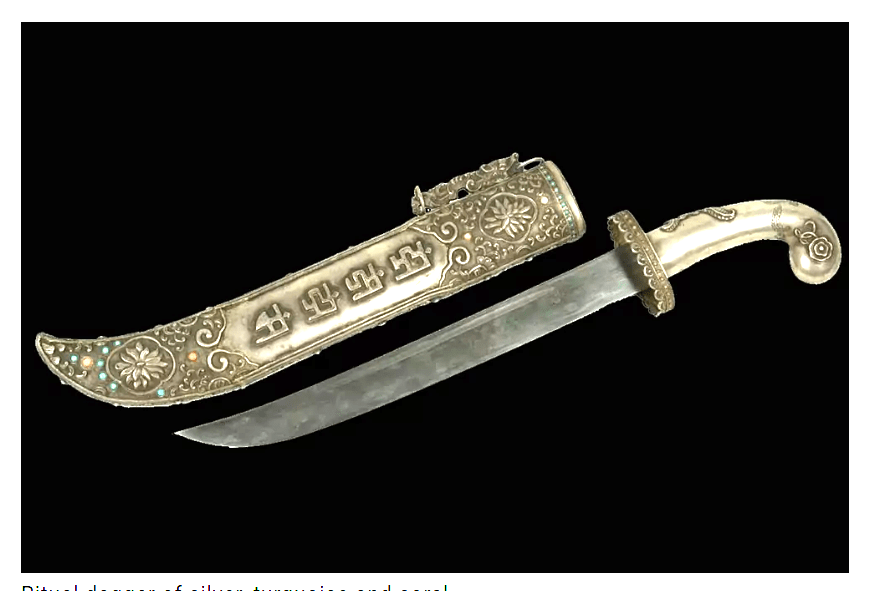
This appears to match the dagger in the top right of the challenge image:

Based on the text of the article (“Judging by his accent, he comes from some city on the northern coast of Spain”), the presumed nationality of the dark web seller is Spanish.
Solution:Spanish

 The eDiscovery Channel
One thought on “Bellingcat Challenge – June 2025 (Cultural Confusion)”