
By Dr Tristan Jenkinson
Introduction
For those who know me and have seen my previous posts on Craig Wright, it will probably come as no surprise that I have been following the COPA v Wright case pretty closely. While I have sadly been too busy to watch the live stream, I have been following along with the live tweets to keep up to date with the proceedings.
Norbert (@bitnorbert) did an exceptional job live tweeting, but was unfortunately only able to cover the first two weeks – thankfully several others have been tweeting out to those following the case, including @BitMEXResearch, @Humble_Bit, @CryptoDevil and @WhatTheFinance9. To get a mix of coverage, I’ve also been reading some of the coverage from Kurt Wuckert Jr (@kurtwuckertjr), “Chief Bitcoin Historian” at Calvin Ayre’s CoinGeek, and ardent supporter of Craig Wright.
I thought that those who haven’t been following the case might be interested in my take, so I’ve pulled together some overall thoughts, and some highlights of potential key points so far. Including a bombshell that landed at the end of day on 26 February.
Let’s start with some overall comments.
Reliance Document Excuses
After opening arguments, Craig took the stand for cross examination. Much of the cross examination was COPA running through the (apparent) forgeries that they have been allowed to put forward in this case. In addition, COPA also went through a large amount of the reliance documents that Wright’s team have submitted in the case to be relied upon to make his case.
After various issues with the documents that Wright had dislosed to support his own case (i.e. evidence that they had been falsified) were put to him, Wright made various claims and excuses.
Some of the reasons that Wright gave for documents that he was to rely upon being inauthentic are well summarized in a Twitter post by @BitMEXResearch:
“1. The signs of manipulation in the document were put there electronically, because:
a. Citrix
b. An nChain staff member accessed or viewed the file
c. Software updated
2. The document is fake, but someone else faked it (For example Ira Kleiman, Greg Maxwell, Robert Macgregor, @agerhanssen, Craig’s wife or someone else).
3. Craig backdated the document, to teach students how to do backdating
4. Craig manipulated the document, as a demonstration for his lawyers
5. Craig backdated the document to 2008, because that is when the Bitcoin project started, as he explained: “I do this sort of thing all the time”
These do not come across as particularly good reasons for why his own reliance documents appear to have been manipulated. The issues and explanations also mean that it is highly unlikely that Wright can rely on these documents in court. Some have asked why he would therefore have put these documents forward. Wright’s argument appears to be that he didn’t (a recurring topic seems to be that his lawyers act entirely independently from his wishes and are not doing what he wants them to do). From the alternative perspective, it would be easy to suggest that they were put forward in hope that they would not be discovered to be falsified. In which case, the evidence showing them to be false meant that Wright has to change tack and has been forced to disown them.
Wright Disowned his Own Expert
The problem with evidence of document manipulation, is that when the evidence is seen by an expert, it can be very difficult to explain away. Wrights own expert has had to admit that documents are inauthentic. This again has left Wright painted into something of a corner, and to try and retain credibility, can only claim that his expert is incorrect
According to reporting from The Guardian Wright said “I didn’t choose Dr Placks, I didn’t want Dr Placks” as well as “Dr Placks is a psychologist. He has a degree in psychology. He has no qualifications in information security”.
Wright was challenged directly about his expert’s suitability, and in the words of Alex Hern of the Guardian:
Asked if his position was that “the expert called by your side is not a suitably qualified expert to give evidence on what he covers in his reports”, Wright said: “If you’re asking me that directly, yes.”
Wright has also referred to his expert as “unqualified” and “unskilled”.
It is unusual for a party to denounce their own expert, but given the responses provided by his expert, it may be that Wright did not feel that he had a choice. On 26 February, Wright indicated that he would no longer be calling his forensic expert to give evidence. This was something that could have been helpful to COPA, since he agreed with the COPA analysis on many documents. In reality, this is unlikely to matter as Justice Mellor will take these actions into consideration.
Justice Mellor is Highly Technical
With an appreciation of Craig Wright’s history and the likely subjects to be covered in the case, this case was always likely to be highly technical. Some had raised concerns of Wright using “technobabble” to confuse the judge. So far it seems that Justice Mellor has demonstrated that he is more than capable of keeping up with the technical discussions – quizzing Wright on the checkBlockHeader function on 14 February, and then checking Howard Hinnant on a statement he made regarding chrono, which Hinnant had misstated.
Thankfully it seems that Justice Mellor is very much up to the job.
Highlights
For me, there have three main highlights (so far) that may have a huge impact on the case as a whole. I’ll discuss the first two here, and will cover one more at the end of the article.
“I do this sort of thing all the time”
Many (including BitMEXResearch and Andy Long) have reported on this apparent self-own from Wright, where he appears to admit to regularly backdating documents. In a discussion with Justice Mellor, Wright stated that he set the date back on a document “because that’s when the project started”. Wright then followed up saying “I do this sort of thing all the time”. Given that he has been accused in this case, and also historically, of manipulating and backdating documents, this was certainly an interesting statement.
Perhaps just as telling was the reported reaction from Justice Mellor.
Unsigned Integers
At one point Wright appeared to struggle to explain what an unsigned integer is. Many have commented in the past about Wright apparent lack of coding expertise, and have seized on his struggles with unsigned integers as a definitive proof that he could not be Satoshi, since the Bitcoin code uses these regularly. This seems something of an overreaction, but Wright’s struggles to explain certainly do not help him.
The LaTeX Animation
Wright provided a number of files from Overleaf, including LaTeX files, which he claim show that he wrote the Bitcoin whitepaper – where Satoshi Nakamoto laid out how Bitcoin would work. LaTeX is an advanced typesetting program used to create documents, often used for technical papers, especially in mathematics or for academic publication.
Wright claimed that there was no history data stored on Overleaf. However, Overleaf is open source, i.e. the code is freely available. Opposing Wright are software developers, who read the code to understand how it worked, according to Greg Maxwell (“nullc” on reddit).
The developers demanded the history from Wright, who upgraded his account to gain access to the history files. What Wright appeared not to have realised was that Overleaf was recording every keystroke he made (something put to Wright by Alexander Gunning for the developers).
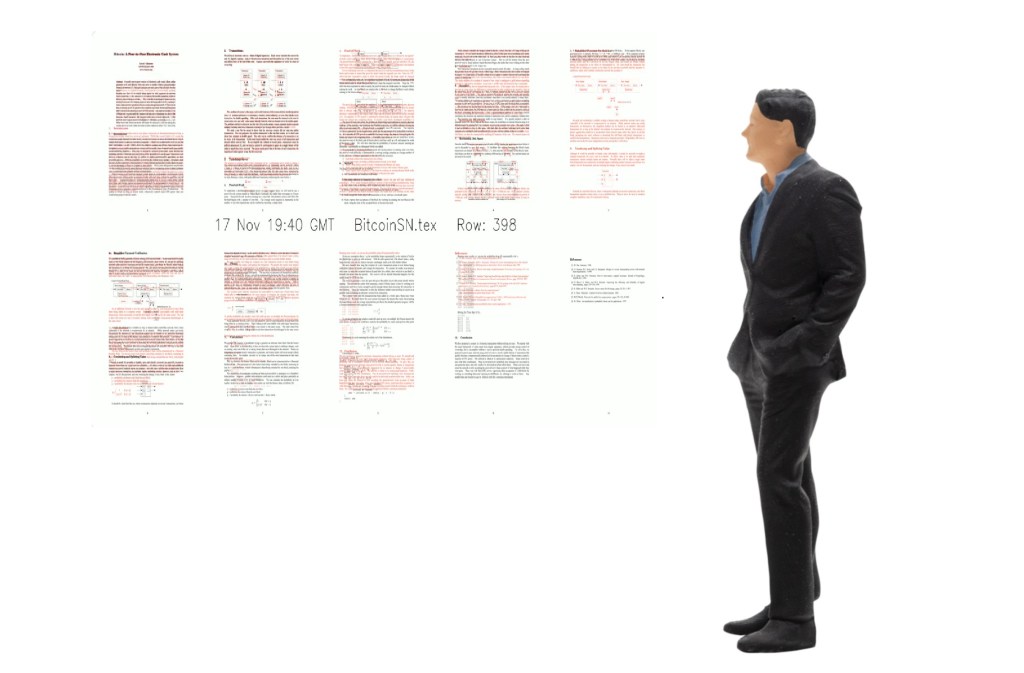
Using the data from Overleaf, the developers were able to put together an animation demonstrating all the changes made to files in the Overleaf LaTeX system.
The animation (in the Twitter post below) shows edits from 17 November to 24 November 2023, updating documents, apparently in efforts to make the output look like the original Bitcoin whitepaper.
Wrights explanation – that he was demonstrating how difficult it would be to falsify the whitepaper.
Justice Mellor raised that if this was the result of a demonstration process, why was the end document disclosed in the case claiming it was the authentic document. Wright claims that it was not, and that he took the original document, changed it, and then spent 22 hours putting it back to exactly how it was as part of the demonstration.
There are however, no logs that demonstrate this is what happened. The logs only show the document being edited towards the end document.
It certainly appears that the LaTeX animation shows Wright trying to generate LaTeX files which would compile to the whitepaper. Those files could then be used (as Wright has claimed) to support his assertion that he is Satoshi.
It is also worth noting that experts from both sides agree that the original Bitcoin whitepaper was written in Open Office.
Still Waiting for Wrights Bombshell
Some have suggested that Wright would reveal a watermark within the Bitcoin whitepaper, demonstrating that he was the creator. Others have even suggested that he may (finally) sign something using one of the keys linked to Satoshi, or even transfer Bitcoin from a Satoshi owned block.
Even his financial backer Calvin Ayre has allegedly said (according to information leaked by from Christen Ager-Hanssen):
“If you have the keys, your best play is to now use them.”
So far, there have been no bombshells from Wrights side of the house… at least, not in support of Wrights case.
However, at the end of the day on 26 February, Wright’s counsel did have a bombshell for the court.
Ontier Confirm Email Falsification
Wright’s accounting records have been part of this case, being relied upon by Wright to support his claims. Patrick Madden (who had been cross examined in the morning) had raised that the screenshots which had been provided were made in March 2020. Wright claims that they were taken by Ontier (his previous lawyers) in 2019, and stated “and I have the emails to prove it”.
In court on 26 February, Wrights current legal team raised that Ontier had sent an email explaining that they had not taken the screenshots in 2019, and had indeed taken them in 2020.
Further, the emails which Wright had produced to the court, to support his statement that the screenshots were taken in 2019, had been compared to emails that Ontier held. In the words of Ontier:
“In light of the above, we are of the view that the email attached to your 11:51 email is not genuine. Understandably, we are keen to ensure that the court is not misled. Please provide us with a copy of the transcript of today’s proceedings and confirm by return how you intend to proceed.”
It appears that Wright’s own lawyers have had to report to the court that he has been providing falsified data. This is far more powerful than the evidence that any of the experts could have given on Wright’s falsification of documents.
The whole issue has been written up very well by BitMEXResearch.
This latest revelation could well lead to Wright’s current lawyers having to decide if they can continue to represent him. Wrights KC, Lord Grabiner, may also have to decide if he can continue representing Wright.
It is worth noting that in similar circumstances Andrew Sommer of Clayton Utz in Australia, decided to terminate all engagements with Wright and his companies in 2015, stating that:
“Information has been provided to our firm which raises serious questions about the integrity of the documents provided by Dr Craig Wright, both to our office and to the Australian Taxation Office”
If his current legal team were to come off the record (i.e. stop representing him), it would be a serious admonishment of Wright’s position, and likely disastrous for his case.
The case continues…


2 thoughts on “COPA v Wright – An Animated End to Craig Wright’s Satoshi Claims??”